

When Attacks Move in Seconds: How CIOs Build Trust with Automated Responses
Published June 17, 2026
This article is the fourth in a series by Ontinue’s security experts.
With the advent of artificial intelligence (AI), true democratization of cyberattacks is no longer a warning, it’s a reality. Skills gaps that once separated sophisticated adversaries from opportunistic cybercriminals are disappearing. At the same time, crime-as-a-service models are expanding at pace from the dominant Ransomware-as-a-Service (RaaS) offerings, due to the ability to generate phishing campaigns, develop malware, automate reconnaissance, and accelerate intrusion activity without having to rely on the same depths of human expertise.
This democratization is converging with a rapidly expanding attack surface, accelerated by cloud adoption and ungoverned “shadow AI” tools, and faster speeds of attack execution, creating a different modern threat environment that CIOs and CISOs need to adapt to.
Faster Defenses Mean Response Autonomy
The traditional incident response operating model of detect, analyze, escalate, discuss, decide, act implicitly assumes there is time to collaborate, time to escalate, and time to get approvals before taking defensive actions. This assumption no longer holds.
While human adversaries may still dwell for days, weeks, or months during their reconnaissance phase, once they decide to act, the actual attack can unfold in seconds, as we’ve seen firsthand in our global Security Operations Center (SOC). The challenge for all SOCs is having the “approved” ability to make split-second, automated responses when warranted to preempt a full-scale attack.
The current security leader practice of “I need to maintain control,” now needs to be, “I need to redefine what control means in a world where humans cannot act faster than AI-built attacks.”
The Collision Point: Sharing Power Between Teams, Including AI
How should CIOs and CISOs approach this adaptation? By shifting to a shared responsibility model – between in-house teams, third-party SOCs, and increasingly, automated systems that they may use. Organizations must confront the difficult but necessary truth that defenders cannot defeat machine-speed attacks with existing levels of organizational decision making that require debate-time about acceptable responses and subsequent authorizations. Whether response is delegated internally to a trusted team or externally to a third-party SOC, organizations must grant pre-approved authority and the gradual use of autonomy for urgent interceptions and defensive actions.
Once an attacker is already positioned inside an environment, a defender’s remaining window is not a governance window. It is an execution window. That is why internal approval chains must be resolved before incidents, not during them.
Bottlenecks caused by humans who need consensus to approve activities are not just inefficient, they are emotionally and operationally difficult for defenders on the frontlines who witness attacks progressing in real-time but are unable to intervene.
Before You Automate: A Decision Checklist
Leveraging AI for incident response is not an argument for reckless automation. Understanding and putting it into practice requires a structured, risk-based approach to that CIOs and CISOs should build incrementally to establish trust, using these seven steps:
1. Start with a target operating model. Every organization has, or should have, a documented set of responsibilities, decision rights, and processes that define how it operates. Most security operating models, however, were designed around the assumption that time exists to collaborate and escalate. CIOs must take the lead in redesigning these models, governance structures, and trust boundaries to reflect the speed requirement of today’s threat environment.
2. Tier your assets and teams. Not everything should be automated, and not everything should be treated the same. Define clear tiers for internal and external teams, including what can be touched, what can be automated, and what is strictly off-limits. A “Do Not Touch” tier is a legitimate and important part of the model, particularly for critical host systems. These scenarios should be tested and determined in advance as much as possible.
3. Understand inputs and outputs, especially reversibility. For every automated response action, ask: What triggers this? What does it do? Can it be undone? Reversibility should be a core design criterion. The ability to undo actions quickly if something goes wrong lowers the risk threshold for acting decisively. Build that capability from the start, not as an afterthought.
4. Build confidence through evidence. Trust in automation comes from historical patterns. This means understanding incident frequency, validating that human responses are consistent, and ensuring automated actions mirror what skilled analysts would do anyway. Confidence is earned incrementally, not assumed.
5. Apply the OODA loop at machine speed. Observe, Orient, Decide, Act. The goal is confidence in your analysis, achieved fast enough to match the pace of the threat. Detection, analysis, and response remain the fundamentals. But in today’s environment, the ability to pre-authorize and execute response at machine speed is what determines whether those fundamentals succeed or fail.
6. Start small and prove it out. Automation doesn’t have to be all-or-nothing. Begin in lower-risk areas. Run tabletop exercises that simulate how an automated response would have played out to build organizational confidence. Tabletops require the right facilitation, but they are one of the most effective tools for moving skeptical stakeholders toward acceptance.
7. Treat setup as a living process. Set-it-and-forget-it is not a strategy. Attackers constantly try new techniques. Microsoft configurations change. Response actions that worked last quarter may break today. CISOs must continuously monitor, test, and update automated responses. Environments evolve, platforms shift, and attackers adapt — which is why automation must be a living adaptable process to keep pace. Third-party SOCs often have a significant advantage here because they operate across a broad customer base, allowing them to encounter low-frequency events, such as Microsoft configuration changes, far more often than any single in-house team, giving them stronger and faster pattern recognition and response calibration abilities.
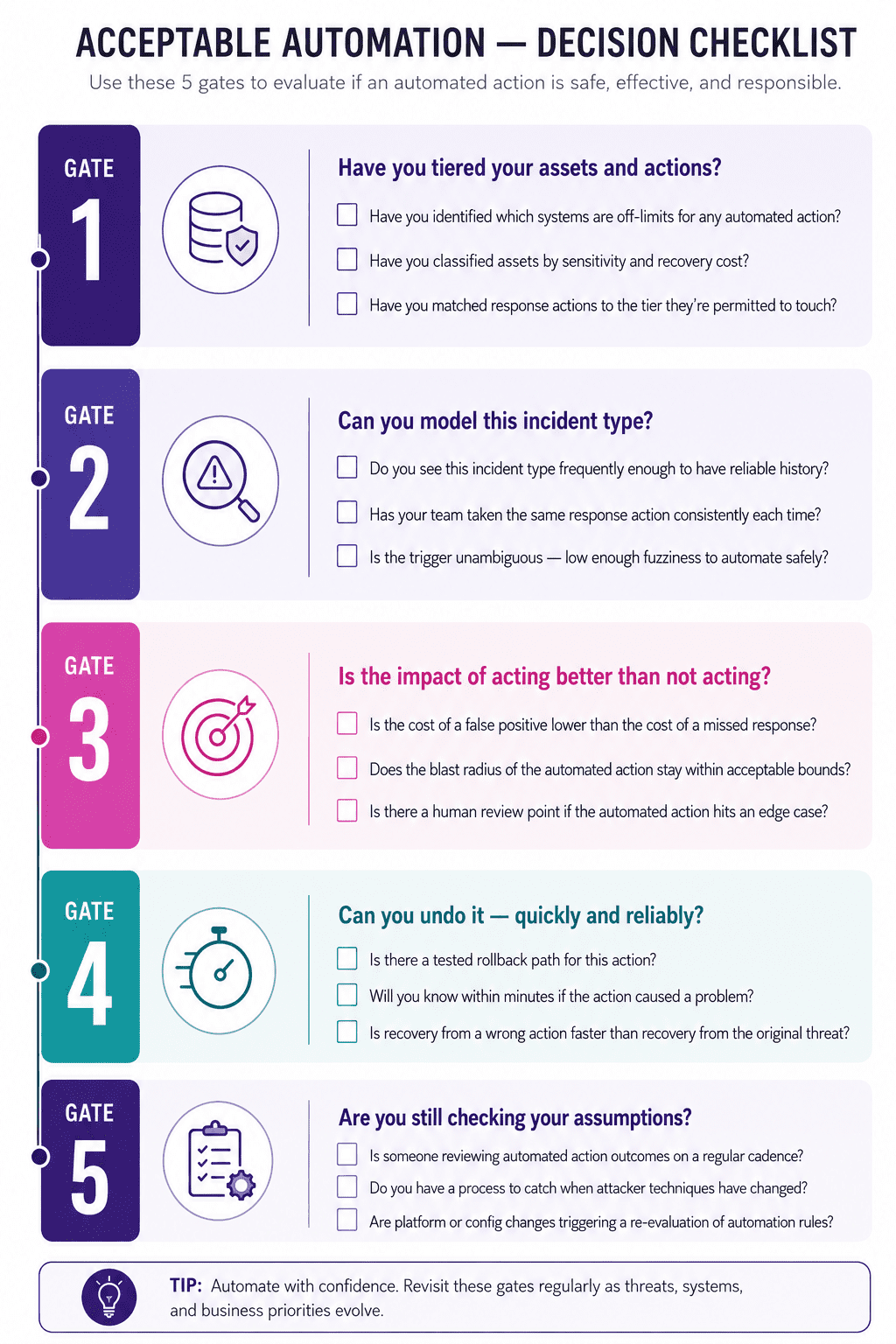
Before greenlighting any automated response action, CISOs should work through the five decision gates below. Each gate surfaces the questions that must be answered, and answered honestly, before moving forward. A single “no” is a signal to stop, resolve the gap, and revisit. This is not a one-time exercise: the fifth gate is intentionally open-ended, because acceptable automation is a living standard, not a fixed destination.
Closing the Trust Gap to Prevent Attacks
Automated response itself is not new. What is new is the speed requirement, and with it, the need for CIOs to help their security leaders redesign operating models and governance structures. Delegating response authority – carefully, visibly, and incrementally – is now a prerequisite for organizational resilience.

Gareth is Chief Security Advisor and CISO for Ontinue. As CISO, Gareth makes sure that Ontinue’s own internal information security – as well as security for the Ontinue ION managed extended detection and response service platform – is appropriate to the threats we face and the trust our customers put in us. As Chief Security Advisor, Gareth also has an outward-facing role to help raise awareness of new threats and novel ways of dealing with them. With Ontinue’s focus on Microsoft technologies, and the importance of people and processes, he helps potential customers understand where our services might fit.